Home›Field notes›Materials
Metal or shingle on the Gulf Coast: how we actually decide
It is not a preference. It comes down to the deck, the slope, how long you are staying and what the wind does to the edge.
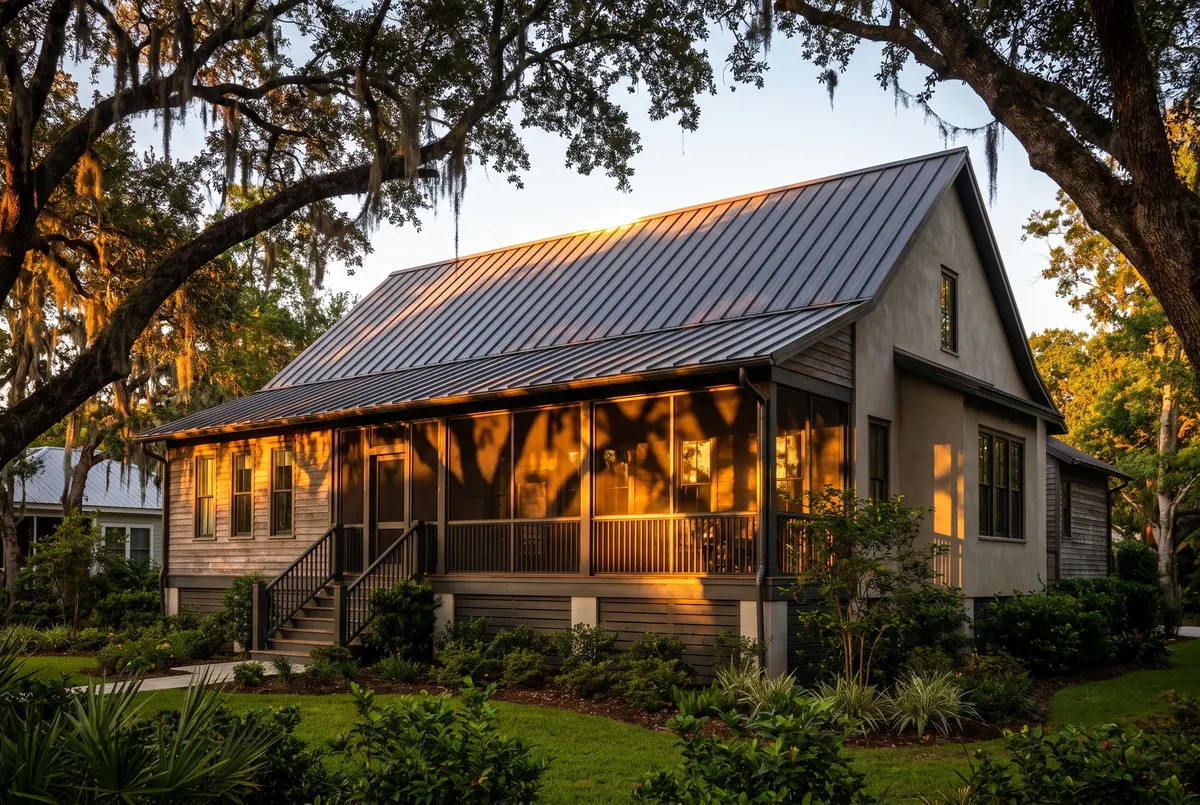
People usually ask which roof is better. The honest answer is that both are good roofs and one of them is right for your building, your slope and how long you are staying. Here is the order we go through it in.
The deck decides first
Neither covering fixes a soft deck. If we can feel movement underfoot or find delamination when we open a corner, that is the first line on the estimate and it applies whichever way you go. Metal is less forgiving here: a standing seam panel is a long straight line, and a wavy deck reads through it in a way that shingles hide.
Slope, and what the edge does in wind
Below about a three in twelve pitch, shingles stop being a sensible choice on this coast and we are into metal or a low-slope membrane. Above that, both work.
What actually fails in a hurricane is almost never the middle of the field. It is the edge: the rake, the eave, the ridge and anything the wind can get a fingernail under. That is where the money should go on either roof. On metal that means a properly fixed cleat and a mechanically seamed panel rather than a snap lock. On shingles it means a sealed starter course at every edge and correct nail placement, which is the single most commonly skipped detail in the trade.
A cheap metal roof fixed badly at the eave will leave before a good shingle roof does. The material is not the variable people think it is.
How long you are staying
A metal roof usually costs two to three times a shingle roof up front and lasts considerably longer, so per year of service life it is often the cheaper roof. That maths only pays out if you are around to collect it. If you are selling in three years, the shingle roof plus the difference in your pocket is a defensible decision and we will say so.
The things people worry about that turn out not to matter
- Noise. Over a solid deck and underlayment, which is how we fit it, a metal roof in rain is close to indistinguishable from a shingle roof from inside the house
- Lightning. Metal does not attract it, and a bonded roof is not a hazard
- Heat. A light-coloured metal roof reflects more than dark shingle absorbs
The things that do
- Colour, because a metal roof shows every wave in the structure under raking light
- Penetrations, because every pipe and vent through a panel is a detail somebody has to get right
- Future work, because walking a standing seam roof to service a unit is a skill, not a stroll
We will walk both options on your roof, price both, and tell you which one we would put on the same house if it were ours.
Why we photograph roofs at seven in the morning
Hail bruising is a shadow, not a colour. At noon there are no shadows, which is how a damaged roof passes an inspection.
Read itThe first 48 hours after a storm, in order
What to do, what to photograph, and the two things people do in the first day that cost them later.
Read itBook a raking-light inspection
We photograph the roof in the hour when the damage shows, and send you the file.
Book it